



 Update
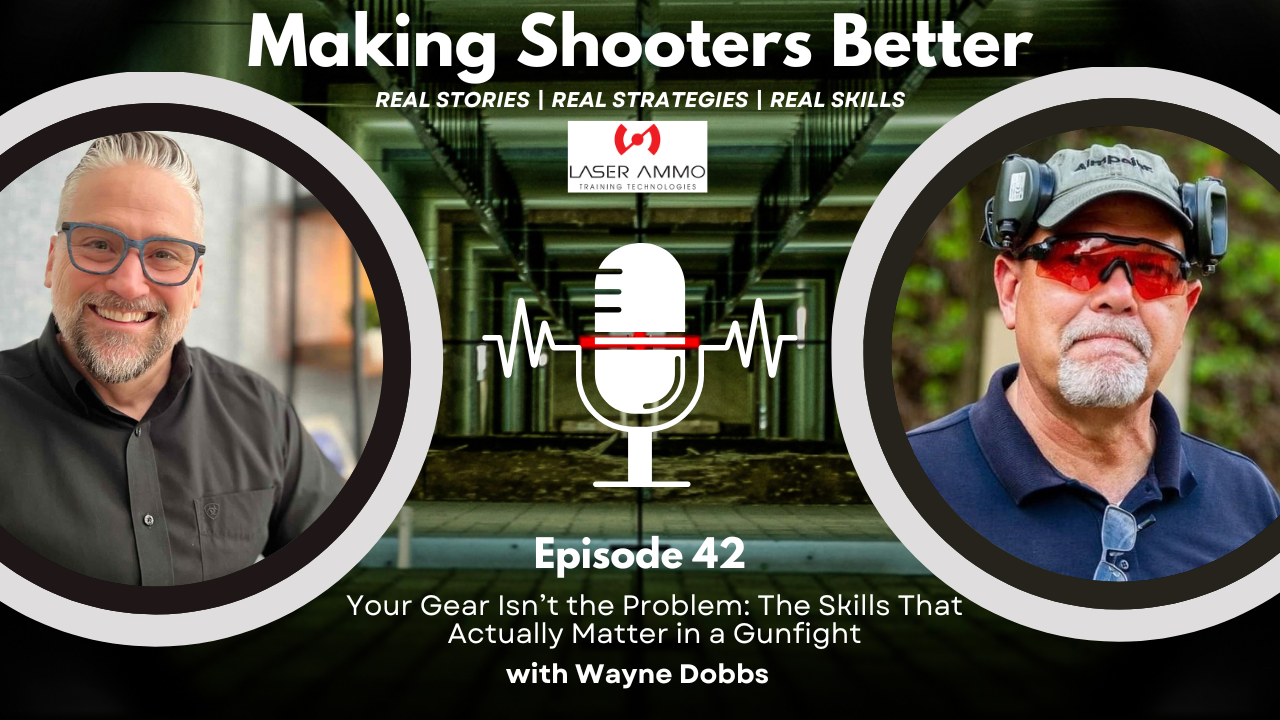
Better equipment can absolutely improve what a shooter is capable of doing. But according to Wayne Dobbs, equipment only takes you so far.
With nearly five decades of firearms instruction and 25 years of law enforcement experience behind him, Wayne has watched training methods, equipment, handgun sights, calibers, and shooting culture change dramatically. Through all of it, one lesson has remained remarkably consistent: strong fundamentals still do most of the work.
In this episode of Making Shooters Better, Wayne joins Terry Vaughan for a wide-ranging discussion about grip, presentation, pistol-mounted optics, reloads, expectations in defensive encounters, situational awareness, and the mental work that needs to happen long before someone ever considers using a firearm defensively.
Why Better Gear Cannot Replace Better Skills
Wayne points to a simple reason shooters are often more willing to buy another trigger, optic, handgun, or accessory than change the way they shoot: buying something is easier.
Changing a deeply established habit requires repetition, feedback, and a willingness to acknowledge that something we have done for years may not be giving us the results we think it is.
Equipment still matters. A reliable firearm, quality ammunition, and a useful sighting system all have a place. The problem begins when equipment is expected to create capability that has never been developed through training.
Fundamentals Become More Important Under Pressure
The conversation repeatedly returns to fundamentals—not as something shooters graduate from, but as skills that become increasingly important as the situation becomes more demanding.
A well-developed skill can require less conscious attention. That leaves more mental capacity available for decisions, changing conditions, movement, communication, and everything else happening around the shooter.
Some of the foundational skills discussed in the episode include:
- Building a consistent grip
- Developing a repeatable presentation
- Managing the trigger without unnecessary disruption
- Maintaining useful visual focus
- Creating processes that hold together when conditions change
The goal is not simply to perform these skills on an easy range drill. It is to make the process repeatable enough that the shooter does not have to devote all of their attention to operating the firearm.
What Red Dots Can Teach Us About Presentation
Wayne has watched pistol sighting systems progress from traditional iron sights through illuminated sights and into the widespread use of pistol-mounted optics.
He is a strong believer in what a properly used red-dot optic can offer, but he also emphasizes that an optic is not a shortcut around poor fundamentals.
In fact, a red dot can make inconsistencies much more obvious.
The Dot Should Confirm the Presentation
One of Wayne’s major points is that shooters who constantly have to search for the dot may need to look at the process that happens before the optic reaches their eye line.
A repeatable grip and consistent presentation help bring the pistol to the same place each time. Instead of making frantic corrections at the end of the movement, shooters can work toward a smoother, more predictable process.
Wayne describes the presentation less as aggressively driving the firearm toward the target and more as allowing it to arrive smoothly and consistently.
That distinction reflects a broader theme throughout the episode: speed should emerge from an efficient process rather than being forced at the expense of the process.
Target Focus Changes the Way the Optic Is Used
The discussion also addresses a common challenge for shooters transitioning from iron sights to an optic.
With a pistol-mounted red dot, the visual goal is not to stare at the dot itself. The shooter remains visually engaged with the intended target area while the dot provides an aiming reference within that view.
This is also why Wayne does not place much importance on debates over whether a red or green dot is universally better. Individual preferences can differ, but color alone does not replace presentation, visual discipline, and the ability to operate the firearm consistently.
Are Shooters Practicing the Right Things?
When Terry asks which skills shooters may spend too much time practicing, Wayne quickly raises two subjects: extremely fast draws and reloads.
His point is not that either skill should be ignored. It is that training time should reflect the problems a person is realistically preparing to solve.
Speed Needs Context
A very fast draw can be an impressive demonstration of shooting skill. Wayne questions, however, whether reducing a draw by a fraction of a second deserves the amount of attention it sometimes receives when other skills may have more influence on the overall outcome.
A fast first action does not eliminate the need for accuracy, decision-making, follow-up performance, or reassessment.
Training should therefore develop the complete process rather than allowing one measurable number to become the definition of competence.
Reloads Should Not Become Automatic Theater
Wayne makes a similar argument about reloads.
Shooters should know how their equipment works and should be capable of keeping it operating. But repeatedly performing reloads simply because a drill always tells the shooter to fire a fixed number of rounds and reload can create training patterns without meaningful context.
Instead, he encourages shooters and instructors to consider why a skill is being practiced, what problem it is intended to solve, and whether the drill supports the behavior they actually want to develop.
Real Encounters Do Not Follow Range Expectations
Another major subject in the conversation is expectation.
Movies, television, range drills, and even years of shooting paper targets can create assumptions about what should happen after a shot is fired. Real events are far less predictable.
Wayne discusses seeing firsthand how people can remain functional after being seriously wounded. That experience changed some of his own earlier assumptions about handgun calibers and terminal performance.
For the defensive shooter, the broader lesson is not to build a plan around an assumed immediate reaction.
Performance has to include observation and reassessment rather than mechanically completing a predetermined sequence.
Equipment Cannot Guarantee an Outcome
This also explains Wayne’s resistance to the idea that a particular caliber, optic, accessory, or performance benchmark can guarantee success.
There is no piece of equipment that eliminates uncertainty.
Good equipment supports good performance. Training builds the capability to use that equipment. Judgment determines whether and how those skills should be applied.
The Most Important Work May Happen Before the Gun Appears
Some of the most valuable parts of the episode have very little to do with shooting mechanics.
Wayne and Terry spend considerable time discussing awareness, recognizing developing problems, realistic expectations, scenario training, and mental preparation.
For anyone who owns or carries a firearm for personal protection, Wayne argues that technical shooting ability represents only part of the responsibility.
Preparation can also include:
- Paying attention to what is changing around you
- Recognizing unusual behavior before a situation develops further
- Understanding the legal principles that apply to defensive force in your jurisdiction
- Thinking through realistic scenarios before facing them
- Knowing when leaving is the better option
- Continuing to practice and maintain skills rather than treating one class as a permanent solution
Wayne describes this as much more of a “software” problem than a “hardware” problem. The equipment is useful, but the decisions still come from the person using it.
Sometimes the Best Response Is to Leave
One of the simplest points in the conversation may also be one of the most important.
If you recognize that a situation is deteriorating and you have a safe opportunity to leave, leaving may solve the problem before physical force ever becomes necessary.
That type of decision is difficult to practice by simply firing more rounds at a range. It requires observation, judgment, scenario work, and an understanding that successful personal protection is not measured by whether a firearm was used.
A Lifelong Approach to Training
Wayne has been shooting since childhood and teaching for decades, yet he closes the conversation by emphasizing that the learning process never really stops.
His own ideas have changed over the years. He has changed opinions about caliber, technique, stance, sights, and training methods as better information and greater experience became available.
That willingness to keep examining what works is an important lesson for shooters at every level.
Training is not about reaching a point where there is nothing left to learn. It is about continuing to refine the fundamentals, testing assumptions, and developing a process that becomes more reliable over time.
Watch the Full Conversation
Watch the full episode of Making Shooters Better to hear Wayne and Terry explore the details behind these ideas, including Wayne’s approach to pistol presentation, what red dots reveal about shooting fundamentals, why some popular range skills may deserve less attention, and how mental rehearsal can help shooters think more realistically about personal protection.
The conversation draws on Wayne’s decades of instruction and law enforcement experience while remaining focused on a practical question every shooter can ask: am I improving the equipment, or am I improving the person using it?
After watching, subscribe to Laser Ammo’s YouTube channel for more episodes of Making Shooters Better and more discussions centered on safe, responsible, effective firearms training.
To learn more about Wayne Dobbs, his classes, and upcoming training opportunities, visit PTG Training and follow him on LinkedIn. Check out the pioneers of the first electric red dot reflex sights, Aimpoint.
Keep Building the Skills Between Range Sessions
Live-fire training remains an important part of firearms skill development, but not every useful repetition requires a trip to the range. Safe dry-fire practice can provide additional opportunities to work on elements such as consistency, visual processing, presentation, and trigger control when performed with an appropriate dry-fire setup and proper safety procedures.
Dry fire should complement—not replace—quality live-fire training. The objective is to create more opportunities for thoughtful, deliberate practice so that the fundamentals become increasingly familiar and repeatable.
Listen to More Episodes
You can listen to Making Shooters Better on your favorite podcast platform. Follow the show here:
- Buzzsprout: https://www.buzzsprout.com/2532363/follow
- Amazon Music https://music.amazon.com/podcasts/8156b69d-5ad9-46e9-9a4d-2baff1fbc9ef/making-shooters-better
- Apple Podcasts: https://podcasts.apple.com/podcast/id1849466402
- Spotify: https://open.spotify.com/show/5EhHThJEeV5QZ0QQn5n5CF
- Podcast Index: https://podcastindex.org/podcast/7559749
- Overcast: https://overcast.fm/itunes1849466402
- Castro: https://castro.fm/itunes/1849466402
- Podchaser: https://www.podchaser.com/podcasts/making-shooters-better-6264190
- Goodpods: https://www.goodpods.com/podcasts-aid/1849466402
- TrueFans: https://truefans.fm/65cb6a8a-c2eb-524e-b742-257cbe7bcfce
- Castbox: https://castbox.fm/vic/1849466402
- Podcast Addict: https://podcastaddict.com/podcast/making-shooters-better/6158896
- iHeartRadio: https://www.iheart.com/podcast/1333-making-shooters-better-303769503/
- Pandora: https://www.pandora.com/podcast
- TuneIn: https://tunein.com/podcasts/