



 Update
What Does It Really Mean to Be Prepared?
Being a capable shooter and being prepared for a real-world emergency are not necessarily the same thing. Accuracy, speed, and familiarity with a firearm are valuable skills, but knowing how to respond when circumstances become unpredictable requires a broader approach to training.
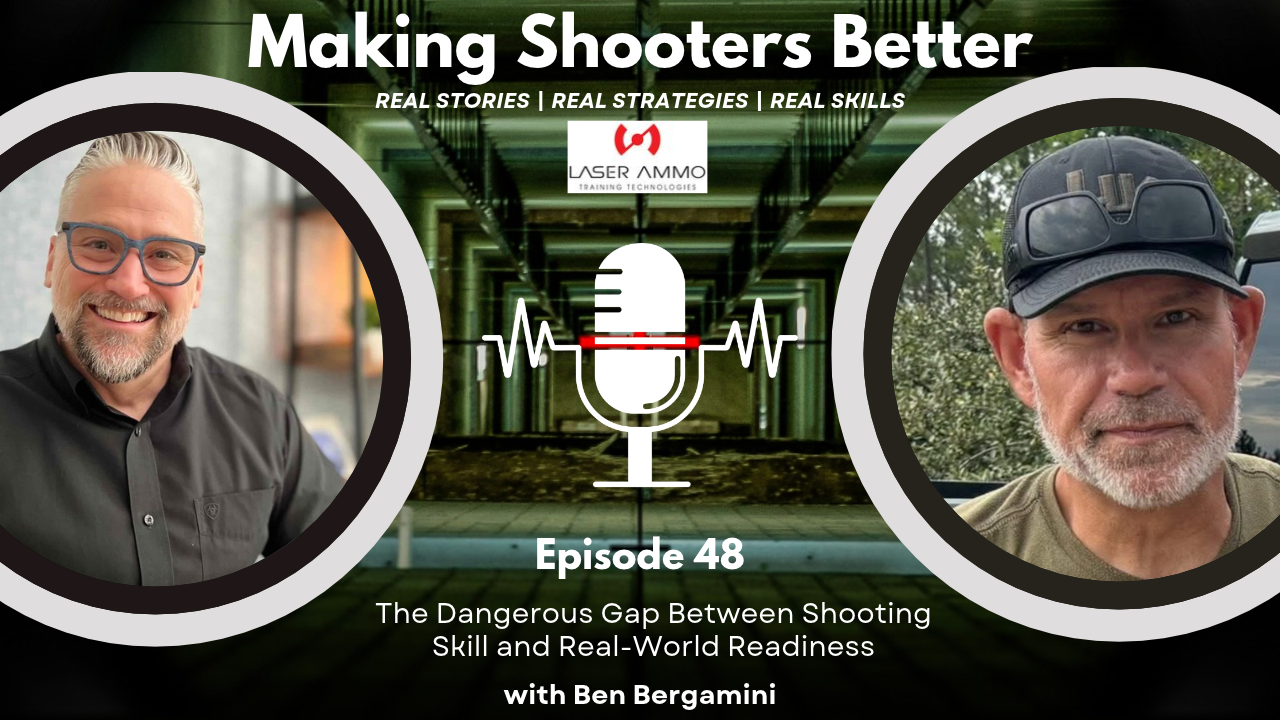
In this episode of Making Shooters Better, host Terry Vaughan welcomes Ben Bergamini, a firearms coach with Haley Strategic whose background includes Division I college football, law enforcement, emergency medical services, and tactical medical instruction.
Drawing on those experiences, Ben discusses how shooters can recognize weaknesses, develop more purposeful training habits, and build skills that extend beyond the shooting range.
The conversation also explores how medical preparedness, communication, teamwork, and the willingness to keep learning contribute to a more complete understanding of personal readiness.
Building Better Shooters Starts With Understanding the Individual
Ben's approach to firearms coaching begins with something that has little to do with shooting: understanding the person being trained.
At Haley Strategic, coaches ask students about their backgrounds, experience, and goals before beginning practical exercises. Someone interested in competitive shooting may have different objectives from a law enforcement officer or a parent seeking to become more capable of protecting their family.
Recognizing those differences helps coaches communicate effectively and establish an environment where students feel comfortable learning.
Why Baseline Assessments Matter
Ben explains that Haley Strategic begins its handgun courses with a Combat Effectiveness Test, or CET, designed to establish a starting point for each student.
During the initial assessment, students complete a series of exercises at varying distances. Rather than immediately focusing on penalties or scores in an open-enrollment class, coaches observe how individuals perform and identify areas that need attention.
These observations help reveal:
- Whether students have consistent fundamentals.
- How performance changes at different distances.
- Which habits may be limiting accuracy or consistency.
- Where individual coaching can provide the greatest benefit.
The purpose is not to embarrass anyone or determine who is the best shooter in the group. It is to establish an honest starting point for improvement.
Ben also emphasizes that every exercise should have a clear purpose. If a student asks why a particular drill is being used, a coach should be able to explain what the student is expected to learn from it.
The Fundamentals Experienced Shooters Still Overlook
When Terry asks which shooting skills are most frequently neglected, Ben identifies two fundamentals that consistently stand out during training: stance and grip.
Despite their importance, both can become inconsistent as shooters develop habits over time.
Why a Consistent Foundation Matters
Ben describes the fundamentals as a progression in which each element supports the next. Establishing a reliable foundation allows shooters to revisit the basics when performance begins to decline or when they have spent time away from regular practice.
His coaching approach emphasizes:
- Establishing a consistent, balanced stance.
- Developing reliable grip habits.
- Understanding how foundational skills affect recoil management.
- Practicing with enough consistency to recognize and correct mistakes.
For Ben, improvement does not always require learning something new. Sometimes the most productive training begins by returning to skills that should already be familiar.
Competition Shooting and Defensive Readiness Are Different Challenges
Terry and Ben also discuss the relationship between competitive shooting and defensive firearms training.
Both recognize the benefits of competition, including pressure, efficiency, problem-solving, and the opportunity to measure performance.
However, they explain that success in a structured shooting competition does not automatically translate into preparedness for a defensive encounter.
Understanding the Purpose of Your Training
Competitive shooting encourages participants to manage time, movement, and accuracy within a known course of fire. A real emergency involves uncertainties and responsibilities that cannot be fully reproduced in a competition environment.
Ben notes that switching between these approaches can be challenging, even for experienced shooters.
The discussion highlights an important distinction: a training activity can be valuable without preparing someone for every situation.
Understanding what a particular training method develops, and what it does not, helps shooters make more informed decisions about their practice.
The Problem With Training Only When It's Convenient
One of the most revealing moments in the episode comes when Ben describes working with a law enforcement agency transitioning to new handguns equipped with optics.
The department offered officers an opportunity to attend a practice session with ammunition provided. Of the 75 sworn officers, only three signed up.
For Ben, the experience illustrated a larger challenge: providing access to training does not guarantee that people will take advantage of it.
He explains that shooting is a perishable skill. Without regular attention, proficiency can decline, even among people who carry firearms professionally.
Making Practice Accessible
Terry connects this discussion to his experience with law enforcement departments using Laser Ammo training equipment.
He explains that some agencies incorporate supplemental dry-fire exercises and simulator-based training into their facilities because officers may struggle to find additional range time after long shifts and family responsibilities.
These shorter sessions create more opportunities for skill development without requiring every practice session to take place at a live-fire range.
Safe, structured dry-fire training can support consistency and reinforce fundamentals, while live-fire training remains an essential part of developing and maintaining firearms proficiency.
Both Terry and Ben emphasize that improvement depends on making training a priority rather than something that happens only when extra time becomes available.
Teamwork Can Make the Difference During an Emergency
Ben's experience in athletics, law enforcement, and EMS has shaped his belief that preparedness depends on more than individual ability.
As a former Division I football player at Western Carolina University, he learned the value of being accountable to teammates. That principle continues to influence his work as a firearms coach and emergency medical professional.
Lessons From Emergency Medical Response
Ben describes how EMS crews prepare while traveling to an emergency. Team members discuss responsibilities, equipment, and their expected roles before arriving at a scene.
That communication becomes especially important during incidents involving multiple patients, emergency vehicles, and responding agencies.
He also recounts a Wilson County courthouse shooting response in which law enforcement, EMS, and fire personnel worked together to manage a rapidly developing emergency.
Although Ben was not personally on scene, he discusses how the responders' training and communication contributed to their coordinated response.
The larger lesson extends beyond professional emergency services. Families and others who prepare together can benefit from discussing responsibilities and expectations before an emergency occurs.
Equipment and individual skills matter, but communication and coordination are also important elements of readiness.
Medical Preparedness Is Part of Real-World Readiness
One of the most important parts of the conversation moves beyond firearms entirely.
When Terry asks which medical skills people should prioritize, Ben recommends beginning with Stop the Bleed training, followed by CPR instruction.
His EMS experience has shown him how quickly serious injuries can become life-threatening and why emergency medical knowledge can matter before professional responders arrive.
Why Stop the Bleed Training Matters
Ben encourages listeners to learn how to recognize severe bleeding and become familiar with appropriate bleeding-control equipment.
He discusses several types of medical supplies, including tourniquets, pressure dressings, and hemostatic products.
Importantly, he also explains that simply owning medical equipment is not enough. Applying it correctly during an emergency can be much more difficult than people expect.
Even experienced professionals benefit from repeating these skills.
Key lessons from the discussion include:
- Seek recognized Stop the Bleed instruction.
- Learn proper tourniquet application through hands-on training.
- Understand the purpose and limitations of your medical supplies.
- Include CPR training in your broader preparedness efforts.
- Continue practicing so important skills remain familiar.
Ben shares examples from emergency medical calls and professional training exercises where effective bleeding control was challenging, reinforcing his point that preparation must include practical experience.
The conversation is a reminder that medical preparedness is useful far beyond firearms-related incidents. Serious injuries can also happen during vehicle accidents and other everyday emergencies.
Why the Best Shooters Continue Training Their Weaknesses
Despite his years of experience, Ben continues seeking instruction from other firearms coaches.
He explains that taking classes outside his own organization gives him opportunities to improve, learn from different teaching approaches, and identify areas where his performance falls short of his personal expectations.
Learning From Other Coaches
Ben specifically mentions working with Justin Dial of Dialed In Training, whose instruction helped him improve his single-hand shooting.
Rather than presenting himself as someone who has already mastered every skill, Ben openly acknowledges that this remains an area he wants to develop further.
He notes that shooters frequently avoid the exercises they find frustrating or uncomfortable, even though those may be the skills that deserve the most attention.
For anyone evaluating their own training, the message is straightforward:
- Be willing to identify skills that need improvement.
- Seek constructive feedback from qualified coaches.
- Remain open to different instructional approaches.
- Measure progress against meaningful personal goals.
- Do not confuse familiarity with proficiency.
Ben's willingness to remain a student is an important part of what makes his perspective valuable. Experience should create opportunities for continued learning, not eliminate the need for it.
Make Purposeful Practice Part of Everyday Life
Near the end of the episode, Terry asks Ben how someone balancing work, family, and other responsibilities can continue improving without unlimited time or resources.
Ben's answer centers on priorities, repeatable habits, and deliberate practice.
He describes how regular firearms practice has become part of his daily routine rather than an occasional activity he tries to fit into his schedule.
Small Sessions Still Need a Purpose
Ben compares effective firearms training to a structured workout. Going to the gym without a plan may provide some activity, but it does not necessarily produce the improvement someone is seeking.
He believes the same principle applies at the range.
Before beginning a practice session, shooters should understand what they want to accomplish and how they will evaluate their progress.
This approach can be applied through:
- Establishing a specific goal for each practice session.
- Scheduling regular opportunities for training.
- Using safe dry-fire exercises to supplement live-fire practice.
- Revisiting fundamentals when performance becomes inconsistent.
- Focusing available time and resources on meaningful improvement.
Terry adds another dimension to the discussion by encouraging people to develop their ability to manage stress through challenging experiences.
Together, their advice reinforces a recurring theme throughout the episode: preparation is an ongoing process built through consistency, honest self-assessment, and purposeful effort.
Preparedness Goes Beyond the Shooting Range
The conversation with Ben Bergamini challenges a narrow definition of firearms proficiency.
Being accurate and efficient with a firearm is valuable, but it is only one part of developing broader readiness.
Ben's experiences across coaching, emergency medicine, law enforcement, and athletics demonstrate how different skills can complement one another.
Effective preparation also involves knowing personal limitations, learning from qualified professionals, maintaining medical skills, communicating with others, and developing habits that support continuous improvement.
Ultimately, the episode encourages shooters to think carefully about why they train and whether their current habits are helping them reach their goals.
Watch the Full Conversation
Join Terry Vaughan and Ben Bergamini for the complete discussion on Making Shooters Better. Hear Ben explain how Haley Strategic approaches individual coaching, why he believes many shooters neglect their weaknesses, and what his EMS experience has taught him about preparation when circumstances change unexpectedly.
The conversation also includes personal examples from firearms instruction, emergency response, and Ben's efforts to balance family responsibilities with professional training. Watch the embedded video below to hear these experiences firsthand and consider how their lessons may apply to your own training.
For more conversations with experienced instructors and shooting professionals, subscribe to Laser Ammo's YouTube channel and follow Making Shooters Better.
Connect With Ben Bergamini
Interested in learning more about Ben's coaching or exploring future training opportunities? Follow him on Instagram, where he welcomes inquiries about his locally organized classes, or explore the Haley Strategic training schedule.
- Ben Bergamini on Instagram: @bergmedhsp
- Haley Strategic Training: https://haleystrategic.com/train
Listen to More Episodes
You can listen to Making Shooters Better on your favorite podcast platform. Follow the show here:
- Buzzsprout: https://www.buzzsprout.com/2532363/follow
- Amazon Music https://music.amazon.com/podcasts/8156b69d-5ad9-46e9-9a4d-2baff1fbc9ef/making-shooters-better
- Apple Podcasts: https://podcasts.apple.com/podcast/id1849466402
- Spotify: https://open.spotify.com/show/5EhHThJEeV5QZ0QQn5n5CF
- Podcast Index: https://podcastindex.org/podcast/7559749
- Overcast: https://overcast.fm/itunes1849466402
- Castro: https://castro.fm/itunes/1849466402
- Podchaser: https://www.podchaser.com/podcasts/making-shooters-better-6264190
- Goodpods: https://www.goodpods.com/podcasts-aid/1849466402
- TrueFans: https://truefans.fm/65cb6a8a-c2eb-524e-b742-257cbe7bcfce
- Castbox: https://castbox.fm/vic/1849466402
- Podcast Addict: https://podcastaddict.com/podcast/making-shooters-better/6158896
- iHeartRadio: https://www.iheart.com/podcast/1333-making-shooters-better-303769503/
- Pandora: https://www.pandora.com/podcast
- TuneIn: https://tunein.com/podcasts/