



 Update
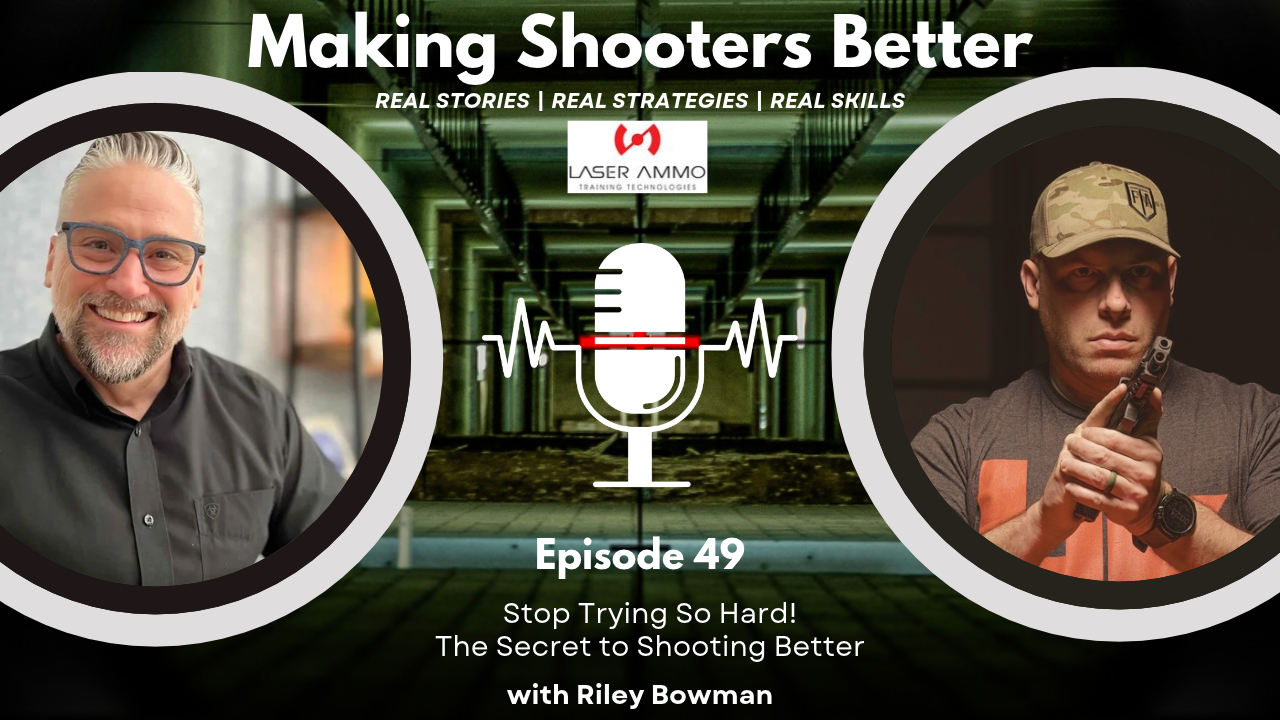
What if the key to becoming a better shooter isn't working harder, but learning to get out of your own way?
In this episode of Making Shooters Better, host Terry Vaughan sits down with USPSA Grand Master and championship-winning competitor Riley Bowman to explore a side of firearms training that doesn't always receive enough attention: the relationship between how we think, what we see, and how we perform.
Drawing from years of competition, instruction, and personal experience, Riley explains why conscious effort sometimes works against skills we've already developed. He also challenges some familiar approaches to firearms instruction and shares how visual awareness, self-discipline, and a healthier mental approach can support meaningful progress.
For new shooters, experienced competitors, instructors, and responsible firearm owners alike, this conversation offers an opportunity to rethink what effective training really looks like.
From Recreational Shooting to USPSA Grand Master
Riley Bowman's introduction to shooting began around age five during family camping trips. Growing up around relatives who enjoyed shooting, he developed an early familiarity with firearms and the fundamentals of marksmanship.
As a teenager, he continued shooting recreationally in Idaho. Later, while participating in reserve law enforcement training, he began recognizing his potential and became more intentional about developing his abilities.
His competitive shooting journey began around 2016, eventually leading him to achieve USPSA Grand Master status.
Today, Riley brings that experience into his work as a firearms instructor, helping students understand not only the physical skills involved in shooting, but also the mental processes that influence how those skills are learned and performed.
Why Self-Awareness Matters
One of Riley's central observations is that highly skilled shooters often have a strong understanding of their own habits and performance.
They become better at recognizing what they're doing, identifying mistakes, and understanding why a particular approach works.
This kind of awareness helps turn practice into productive learning rather than simply repeating the same motions.
- Recognizing patterns in your performance creates opportunities for improvement.
- Understanding your strengths helps reinforce techniques that already work.
- Identifying unproductive habits makes training more purposeful.
- Developing self-awareness supports better decision-making and greater confidence.
But as Riley explains, there's an important distinction between being aware of what you're doing and consciously trying to control every detail while performing.
The Flow State: When Less Thinking Leads to Better Performance
Most shooters have experienced moments when everything seems to come together. Their movements feel natural, their attention remains focused, and the process seems almost effortless.
Riley connects these experiences to what is commonly described as a flow state.
Rather than consciously directing every physical action, a shooter allows previously developed skills to operate with less interference from deliberate thought.
Why Trying Harder Can Backfire
During training, conscious analysis plays an important role. Shooters need opportunities to understand techniques, recognize errors, and make adjustments.
However, attempting to mentally control every component of a familiar skill during performance can create unnecessary distractions.
Riley describes how this became a challenge during his own competitive development. As he worked toward higher goals, he initially believed that greater physical effort and technical adjustments were the answers to his performance plateaus.
Eventually, he realized that his mental approach was contributing to the problem. His guiding reminder became simple: stop trying so hard and just do the thing.
Focus on the Process, Not the Result
Instead of approaching every shooting exercise with expectations about speed, scores, or perfect outcomes, Riley encourages a more process-oriented mindset. That means directing attention toward the information and decisions that matter in the present moment rather than becoming preoccupied with the final result.
For Riley, visual attention is an especially valuable part of this approach. By concentrating on what he needs to see, rather than constantly thinking about shooting faster or achieving a particular score, he creates the conditions for his practiced skills to work more naturally.
This distinction can be useful at every level of experience. The goal isn't to eliminate thoughtful instruction or preparation. It's to recognize when analysis is helpful and when excessive thinking becomes a distraction.
Train Your Eyes: The Importance of Visual Awareness
One of the most interesting discussions in the episode centers on the role of vision in shooting performance. Riley believes that firearms instruction frequently emphasizes physical mechanics without giving equal attention to how shooters use and interpret visual information.
His signature Pistol Intelligence class places considerable emphasis on helping students understand visual awareness and deliberate attention.
Learning to See with Greater Intention
Throughout the day, our eyes constantly collect information. We notice movement, recognize objects, and shift our attention without giving much thought to the process.
Riley points out that this automatic behavior doesn't necessarily mean we've developed the discipline to direct our attention intentionally.
In his instruction, he encourages students to become more aware of where they're looking and what information is relevant to the task in front of them.
This has implications beyond marksmanship. In responsible firearms training, recognizing the surrounding environment and making sound decisions are essential parts of safe performance.
A Simple Exercise in Visual Awareness
During the conversation, Riley describes an interesting exercise involving a blank sheet of white paper.
When someone attempts to maintain visual attention on the center of a featureless page, they may discover how readily their eyes begin searching for edges, corners, or other reference points.
The exercise illustrates how difficult sustained visual attention can be, even when the task appears simple. It's also a reminder that developing awareness doesn't always require complicated equipment.
Why Visual Training Deserves More Attention
Riley's teaching emphasizes several important ideas:
- Visual attention is a skill that can be developed intentionally.
- Recognizing relevant information is an important part of responsible decision-making.
- Awareness of visual habits can help shooters better understand their performance.
- Reducing unnecessary mental distractions can create more productive learning experiences.
For firearms instructors, his perspective offers an interesting opportunity to examine how visual instruction fits alongside traditional fundamentals.
Rethinking Firearms Instruction: Red Dots Before Iron Sights?
One of the episode's biggest surprises comes when Terry and Riley discuss how new shooters are traditionally introduced to aiming systems.
Many experienced shooters learned with iron sights before progressing to red-dot optics. Riley suggests there may be advantages to reversing that order for some beginners.
Reducing the Learning Curve
Riley argues that a new shooter already has a great deal of information to process. They may be learning safe firearm handling, stance, grip, visual alignment, and trigger control all at once.
Adding a more complicated aiming system can increase the amount of information they must manage while learning these unfamiliar skills.
From Riley's perspective, beginning with red-dot optics may simplify one part of the learning experience, allowing students to devote more attention to other foundational concepts.
Challenging Tradition Without Abandoning Fundamentals
This approach doesn't mean Riley believes iron sights are unimportant. Instead, he suggests that changing the order of instruction may help some students build confidence before moving to additional technical challenges.
Terry, who initially describes his own teaching approach as more traditional, finds the idea particularly compelling.
The exchange highlights a valuable principle for instructors: established methods deserve respect, but thoughtful alternatives can help us reconsider how different students learn.
Regardless of equipment or instructional approach, proper supervision, safe firearm handling, and consistent attention to fundamentals remain essential.
The Mental Challenges That Hold Shooters Back
Technical knowledge and experience don't automatically eliminate performance anxiety.
Even accomplished competitors can struggle with self-doubt, unrealistic expectations, and the pressure to perform at their highest level.
Riley speaks openly about his own experiences with negative self-talk and the frustration of pursuing improvement without seeing the results he wanted.
Recognizing Negative Self-Talk
Riley explains how easily a disappointing result can turn into a cycle of self-criticism. Rather than treating an imperfect performance as useful information, shooters may become frustrated with themselves or worry about how others perceive their abilities.
That additional pressure can make it more difficult to remain engaged with the learning process.
His teaching encourages students to recognize these thought patterns and develop a more constructive relationship with their performance.
- Approach mistakes as information rather than personal failures.
- Separate your expectations from what actually happened.
- Recognize when frustration is interfering with concentration.
- Give yourself opportunities to evaluate progress without unnecessary comparison.
- Remember that consistent improvement requires patience and deliberate practice.
The Five-Shot Exercise
Early in his classes, Riley asks students to deliver their best five shots without the pressure of a timer. Afterward, he asks whether they believe they truly performed to the best of their current ability.
According to Riley, very few students express complete satisfaction. That response becomes the starting point for a discussion about expectations, attention, and the internal pressures people bring into a learning environment.
The lesson extends well beyond shooting. Sometimes the greatest obstacle to learning is the demand we place on ourselves to perform perfectly.
When Life Interrupts: Riley's Competition-Day Vehicle Fire
Managing performance pressure is challenging enough under normal circumstances. But what happens when an unexpected emergency disrupts everything?
Riley shares a remarkable experience involving his vehicle catching fire while traveling to a major shooting competition. The incident resulted in lost equipment and significant disruption just before he was scheduled to compete.
While he acknowledges that his eventual performance wasn't everything he had hoped for, the experience provides an important perspective on managing distractions and adapting when circumstances are beyond our control.
Separating What You Can Control from What You Can't
Unexpected problems can affect anyone, whether they're preparing for competition, attending a training class, or managing an ordinary stressful day.
Riley's experience reinforces the importance of recognizing what can be controlled in the present rather than remaining consumed by circumstances that cannot be changed.
Preparation matters, but so does adaptability. For shooters, maintaining perspective can support more productive decisions when conditions aren't ideal.
Making Practice More Purposeful
Another theme running throughout the episode is the difference between simply practicing and practicing with intention.
Riley and Terry discuss how a productive training session should offer opportunities to observe, evaluate, and learn.
Spending time at the range doesn't automatically guarantee progress. Meaningful improvement comes from understanding what the practice is intended to develop and evaluating the results.
A Shooting Assessment Worth Exploring
Toward the end of the episode, Riley shares a shooting assessment developed by fellow competitive shooter Tim Herron. The exercise introduces time pressure and scoring considerations that encourage shooters to balance accuracy, attention, and consistency.
Rather than emphasizing speed alone, the assessment creates opportunities to observe how performance changes when different demands are introduced. Terry appreciates the idea of returning to a consistent challenge over time to evaluate progress and identify areas that need additional attention.
Any live-fire drills should be conducted only in an appropriate, authorized range environment with proper safety procedures and qualified supervision where needed.
Applying the Lessons to Responsible Training
Several of the episode's broader principles can also inform safe, structured dry-fire training.
- Set a clear learning objective before each practice session.
- Pay attention to consistency and the quality of repetitions.
- Use appropriate training tools to support focused skill development.
- Reflect on what you've learned rather than judging every session by one result.
- Combine regular practice with qualified instruction and appropriate live-fire training.
Laser Ammo offers dry-fire training solutions that can help shooters create more opportunities for structured practice without live ammunition. Dry-fire training is a supplement to, not a replacement for, live-fire practice and professional instruction.
Always follow proper firearm safety procedures, including removing live ammunition from the training area, verifying the firearm is unloaded, maintaining a safe direction, and following the instructions for your training equipment. Explore available training solutions at Laser Ammo.
Becoming a Better Shooter Starts with Better Awareness
Perhaps the most important lesson from Riley's conversation with Terry is that shooting improvement isn't exclusively a physical process. Training also involves how we observe, interpret information, manage expectations, and respond to setbacks.
Riley's experience illustrates how meaningful progress can come from changing the way we approach learning rather than simply increasing our effort. Whether you're developing basic familiarity, improving competitive performance, or helping others learn safe firearm handling, the ability to evaluate your own habits and remain open to new ideas is valuable.
Better shooting doesn't always require more effort in the moment. Sometimes it requires better preparation, clearer attention, and enough confidence to allow your training to work.
Watch the Full Conversation
There's much more to discover in Terry Vaughan's conversation with Riley Bowman, including the experiences that shaped Riley's approach to instruction, the book that influenced his competitive development (Practical Shooting: Beyond Fundamentals by Brian Enos), and the mental strategies he uses to approach demanding situations.
Watch the full Making Shooters Better episode in the embedded video below to hear Riley explain why he believes visual awareness deserves a larger role in firearms training, how his teaching philosophy has evolved, and what shooters can learn from challenging their own assumptions.
You'll also hear the discussion about introducing red-dot optics to beginners, managing negative thought patterns, and using purposeful assessments to evaluate progress.
If you enjoy practical conversations about responsible firearms training, subscribe to Laser Ammo's YouTube channel for more episodes of Making Shooters Better featuring experienced competitors, instructors, and industry professionals.
Connect with Riley Bowman
Interested in learning more about Riley's instruction, competitive shooting experience, and approach to firearms education?
Follow his work, explore his training opportunities, and connect through his website and social media channels.
- Personal Website: www.rileybowman.com
- Concealed Carry: concealedcarry.com
- Instagram: @rileyconcealedcarry
- Facebook: Riley Bowman on Facebook
- X: @rileytbowman
You can also hear more from Riley through The Concealed Carry Podcast, where he and his team explore firearms training, personal protection, preparedness, and responsible decision-making.
For more information about Laser Ammo and our approach to helping shooters build skills through responsible practice, check out our site.
Listen to More Episodes
You can listen to Making Shooters Better on your favorite podcast platform. Follow the show here:
- Buzzsprout: https://www.buzzsprout.com/2532363/follow
- Amazon Music https://music.amazon.com/podcasts/8156b69d-5ad9-46e9-9a4d-2baff1fbc9ef/making-shooters-better
- Apple Podcasts: https://podcasts.apple.com/podcast/id1849466402
- Spotify: https://open.spotify.com/show/5EhHThJEeV5QZ0QQn5n5CF
- Podcast Index: https://podcastindex.org/podcast/7559749
- Overcast: https://overcast.fm/itunes1849466402
- Castro: https://castro.fm/itunes/1849466402
- Podchaser: https://www.podchaser.com/podcasts/making-shooters-better-6264190
- Goodpods: https://www.goodpods.com/podcasts-aid/1849466402
- TrueFans: https://truefans.fm/65cb6a8a-c2eb-524e-b742-257cbe7bcfce
- Castbox: https://castbox.fm/vic/1849466402
- Podcast Addict: https://podcastaddict.com/podcast/making-shooters-better/6158896
- iHeartRadio: https://www.iheart.com/podcast/1333-making-shooters-better-303769503/
- Pandora: https://www.pandora.com/podcast
- TuneIn: https://tunein.com/podcasts/