


 Update
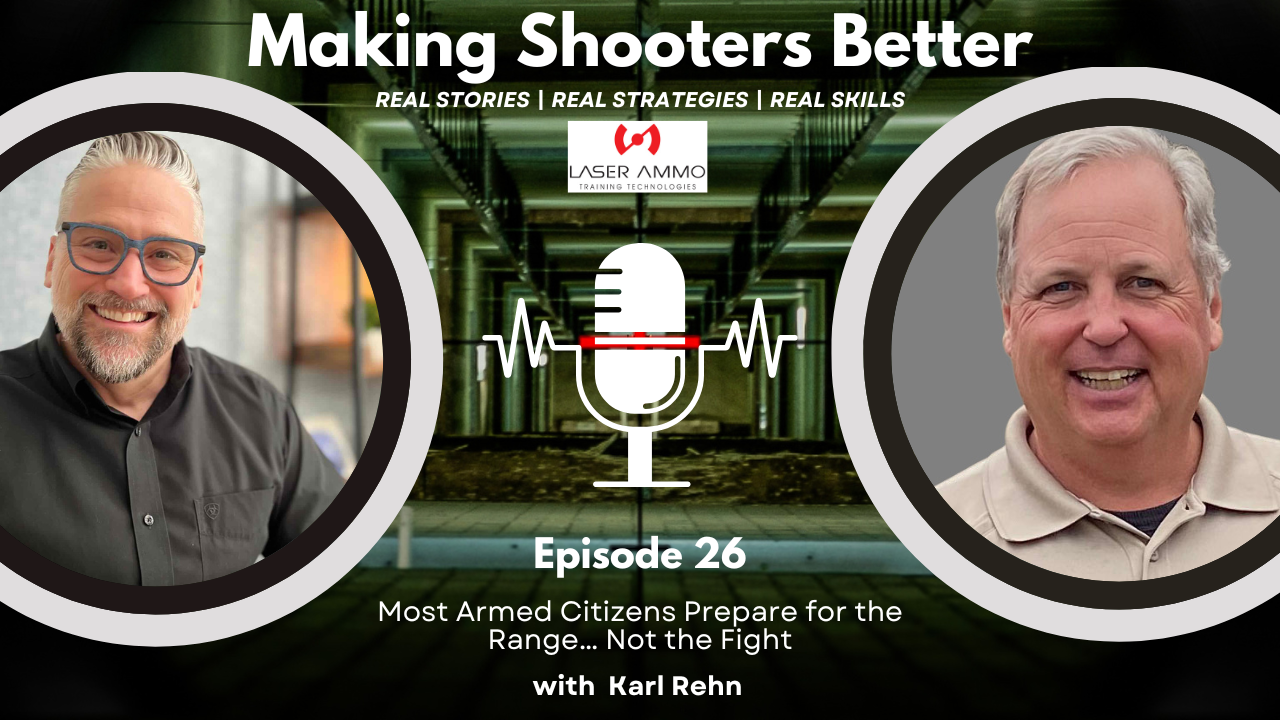
In this episode of Making Shooters Better, Terry Vaughan is joined by firearms instructor Karl Rehn of KR Training for a practical and honest conversation about what responsible armed citizens often miss in their training.
Karl has spent decades teaching armed citizens, law enforcement officers, and competitive shooters. He has also remained a dedicated student, with thousands of hours of formal training from instructors across the firearms training world.
The result is a grounded perspective on what helps people become better shooters, and what helps them become better prepared for real-world defensive situations.
The Gap Between Shooting Skill and Preparedness
Many gun owners spend their time working on marksmanship, speed, and range performance. Those skills matter, but Karl explains that they are only part of the bigger picture.
In a real self-defense situation, the hardest part may not be pressing the trigger. It may be seeing the problem early, making the right decision under stress, and knowing when not to get involved.
Why Qualifications Can Create False Confidence
Karl points out that many shooters stop training once they meet a minimum requirement. That might be a concealed carry qualification, a department standard, or a basic range test.
The problem is that minimum standards are not the same as real preparedness.
- They often use predictable drills
- They rarely include decision-making
- They do not test awareness or judgment
- They may not reflect the gear people actually carry
Competition Shooting Helps, Until It Does Not
Karl has a long background in competitive shooting, and he gives competition credit where it is due. Competitive shooters tend to set goals, track performance, and practice with purpose.
Those habits can make a major difference for anyone serious about improving with a handgun.
What Competitive Shooters Often Do Well
- Measure performance honestly
- Use timers and standards
- Analyze mistakes
- Practice more consistently
- Develop stronger gun handling skills
At the same time, Karl explains that competition is not the same as a defensive encounter. A stage gives the shooter a plan. A real-world situation may give them confusion, movement, unknown people, legal consequences, and very little time.
Train With the Gear You Actually Carry
One of Karl’s strongest points is that shooters should test themselves with their actual carry setup. A full-size range gun, competition holster, or optimized belt may produce better results, but those results may not reflect what happens with everyday carry gear.
Responsible training should include the firearm, holster, clothing, and carry method a person actually uses outside the range.
Realistic Gear Practice May Include
- Drawing from concealment
- Working from everyday clothing
- Testing small carry guns
- Practicing with real holsters and retention methods
- Understanding the limits of deep concealment
Decision-Making Is a Skill
One of the biggest themes of the episode is decision-making under stress. Karl explains that much of firearms training is built around pre-planned actions. A signal happens, a target appears, and the shooter performs a known task.
Real life is not that clean.
Scenario-based training and well-run force-on-force exercises can expose important gaps. Sometimes the best answer is to leave, create distance, use verbal skills, call for help, or avoid becoming involved in a situation that does not require you.
Force-on-Force Training Can Reveal:
- Whether a person recognizes danger early
- Whether they can make decisions under pressure
- Whether they understand distance and timing
- Whether they can avoid pointing a firearm at non-threats
- Whether they know when not to shoot
Skills Beyond the Firearm
Karl also emphasizes that real-world preparedness is broader than shooting. In his experience, medical skills have been used more often than firearm skills.
For armed citizens, a stronger training plan should include more than range work.
Important Supporting Skills
- Basic emergency medical training
- Unarmed skills and weapon retention
- Pepper spray use and carry
- Low-light training
- Awareness in transitional spaces
- Understanding legal and practical consequences
A Smarter Training Roadmap
For someone who carries daily and wants to become better prepared over the next year, Karl recommends realistic standards and a broader approach to training.
That may include building measurable handgun skill with carry gear, taking medical and low-light classes, learning unarmed fundamentals, and watching real incidents to better understand how quickly situations unfold.
Watch the Full Conversation
This episode is a valuable reminder that good training is not about fear. It is about awareness, responsibility, and building skills that hold up when conditions are not perfect.
Watch the full conversation to hear Karl Rehn’s complete perspective on competition shooting, concealed carry, force-on-force training, medical skills, and how armed citizens can build a more realistic training plan.
Follow Karl and KR Training on Facebook, on X/Twitter at KRTraining, and on Instagram at KRTraining. You can also visit KRtraining.com and blog.KRtraining.com for classes, articles, and more training resources.
Subscribe to Laser Ammo’s channel for more episodes of Making Shooters Better, featuring practical conversations with instructors, competitors, and professionals focused on safer, smarter firearms training.
Listen to More Episodes
You can listen to Making Shooters Better on your favorite podcast platform. Follow the show here:
- Buzzsprout: https://www.buzzsprout.com/2532363/follow
- Amazon Music https://music.amazon.com/podcasts/8156b69d-5ad9-46e9-9a4d-2baff1fbc9ef/making-shooters-better
- Apple Podcasts: https://podcasts.apple.com/podcast/id1849466402
- Spotify: https://open.spotify.com/show/5EhHThJEeV5QZ0QQn5n5CF
- Podcast Index: https://podcastindex.org/podcast/7559749
- Overcast: https://overcast.fm/itunes1849466402
- Castro: https://castro.fm/itunes/1849466402
- Podchaser: https://www.podchaser.com/podcasts/making-shooters-better-6264190
- Goodpods: https://www.goodpods.com/podcasts-aid/1849466402
- TrueFans: https://truefans.fm/65cb6a8a-c2eb-524e-b742-257cbe7bcfce
- Castbox: https://castbox.fm/vic/1849466402
- Podcast Addict: https://podcastaddict.com/podcast/making-shooters-better/6158896
- iHeartRadio: https://www.iheart.com/podcast/1333-making-shooters-better-303769503/
- Pandora: https://www.pandora.com/podcast
- TuneIn: https://tunein.com/podcasts/