



 Update
Training for Decisions, Not Just Marksmanship
Firearms proficiency matters, but this episode makes clear that technical shooting ability is only one part of responsible preparation.
A defensive incident may require someone to recognize a threat, communicate clearly, move to a safer position, protect another person, create distance, or leave the area entirely. The firearm may never need to be used.
That is why scenario-based training can be so valuable. It gives students an opportunity to practice making decisions while processing uncertainty and pressure.
Useful training scenarios should allow participants to consider options such as:
- Leaving before the situation becomes violent
- Moving toward an available exit
- Creating distance or using available cover
- Using clear verbal commands
- Attempting de-escalation when circumstances allow
- Recognizing when a threat has ended
- Identifying when force is not necessary
The goal is not to force every scenario toward a shooting. The goal is to develop better judgment and give the student more options to recognize under stress.
Understanding Law-Driven Tactics
Von describes an important training concept he calls law-driven tactics. These are actions taught before an incident that may support better decisions during the event and help explain those decisions afterward.
A person facing an immediate threat may not have time to work through a legal checklist. Under pressure, people often rely on familiar patterns developed through training and experience. That makes it important to build legally relevant actions into training before they are needed.
Depending on the circumstances, law-driven tactics may include:
- Giving a verbal warning when time permits
- Attempting to disengage or avoid the confrontation
- Creating distance from the threat
- Moving behind a barrier or other available cover
- Using communication and verbal persuasion
- Presenting a firearm as a warning before firing, when legally and tactically appropriate
- Stopping force when the threat is no longer present
Not every option will be safe, practical, or legally required in every situation. The circumstances may develop too quickly for a warning, retreat, or de-escalation attempt.
However, when those options are available, using them may help prevent violence and demonstrate that the person made reasonable efforts to avoid using force.
Build the Mental File Before the Emergency
Von explains that training helps create mental “file folders.” When a rapidly unfolding threat resembles something a person has previously studied or practiced, that pattern may be recognized more quickly.
Afterward, however, the decision may need to be reconstructed in detail. Saying that something felt wrong may not adequately explain what the person observed or why the threat seemed imminent.
Quality education can provide the vocabulary needed to explain:
- What behavior was observed
- What the person believed that behavior meant
- Why the threat appeared capable of causing death or serious injury
- What options seemed available at the time
- What actions were taken to avoid or reduce the danger
- Why the eventual response appeared reasonable
This does not mean memorizing language to justify a bad decision. It means learning to recognize relevant facts, make responsible choices, and accurately describe what happened.
Documenting Your Training
The discussion also highlights the value of maintaining clear training records.
Training history can help establish why someone recognized a particular danger, understood how quickly an attack could develop, or selected a certain response. It can also show that the person took firearm ownership and self-defense responsibilities seriously.
Useful records may include:
- Course names and completion dates
- Instructor names and credentials
- Certificates of completion
- Course descriptions or lesson outlines
- Documented scenario-based training
- De-escalation and communication instruction
- Medical and emergency-response training
- Regular dry-fire and live-fire practice logs
Dry-fire practice can help reinforce safe firearm handling, presentations, trigger control, and other mechanical skills. It should always be conducted with a verified unloaded firearm in an appropriate practice area and should complement, not replace, responsible live-fire training.
Training records alone do not make a use of force lawful. They may, however, help attorneys and experts understand the person’s knowledge, preparation, and decision-making process.
The Financial Reality of a Legal Defense
A use-of-force case can involve far more than attorney fees.
Von explains that a complete defense may require specialists from several fields, depending on the evidence and disputed issues in the case.
A defense team could include:
- Use-of-force and police-practices experts
- Human-performance specialists
- Video and audio analysts
- Medical professionals
- Biomechanical engineers
- Electrical or weapons-system engineers
- Exercise physiologists
- Investigators and reconstruction specialists
These experts may be needed to explain issues that are not obvious to a judge or jury, including reaction time, exhaustion, perception, weapon capabilities, injury potential, and the limitations of video evidence.
Even an incident between two civilians on an ordinary evening can become a complex and expensive legal case.
Evaluating Self-Defense Coverage
The episode encourages responsibly armed citizens to seriously consider the financial resources that could be required after a defensive incident.
Self-defense coverage plans differ significantly. Before choosing one, consumers should compare the terms carefully and understand exactly how a claim would be handled.
Questions worth asking include:
- Does the plan cover firearm and non-firearm self-defense incidents?
- Are attorney fees paid immediately or reimbursed later?
- Can the member select an attorney?
- If an attorney is assigned, do they have meaningful self-defense experience?
- Does coverage include expert witnesses and investigators?
- Are civil proceedings covered as well as criminal proceedings?
- Can the provider decline a case after making its own initial judgment?
- Are there financial caps, exclusions, or repayment requirements?
The purpose of reviewing coverage is not to assume that a defensive incident will happen. It is to understand the potential consequences and make an informed decision before help is needed.
A Message for Future Jurors
Most people will never be involved in a defensive shooting, but many may eventually be asked to serve on a jury.
Von asks potential jurors to recognize that much of what the public believes about violence comes from television, movies, and edited video. Real violence is faster, less predictable, and more consequential than entertainment usually portrays.
A juror may need to consider facts that are unfamiliar or uncomfortable, including:
- A single punch can cause death or permanent injury
- An edged-weapon attack can close distance quickly
- A person under threat may not perceive everything recorded by a camera
- Stress can affect attention, memory, hearing, and time perception
- The defender may have had fewer options than hindsight suggests
- A tragic outcome does not automatically establish an unlawful act
Jurors should remain open to qualified expert testimony and evaluate the incident according to the law they are given, rather than the outcome they wish had occurred.
It is possible to dislike an outcome while still concluding that the person’s actions were legally reasonable.
Preparation Must Begin Before the Incident
The central lesson of this conversation is that responsible preparation extends far beyond carrying a firearm.
It includes understanding the law, improving judgment, practicing communication, recognizing opportunities to disengage, and learning how stress can influence perception and performance.
Responsible preparation may involve:
- Safe and consistent firearm practice
- Scenario-based decision-making
- Threat-recognition education
- Conflict avoidance and de-escalation
- Clear verbal communication
- Medical training
- Knowledge of local self-defense law
- Accurate documentation of completed training
- A realistic plan for obtaining legal assistance
No training can guarantee a perfect response. Better preparation can provide more choices, improve recognition, and support clearer decisions when time is limited.
Watch the Full Conversation
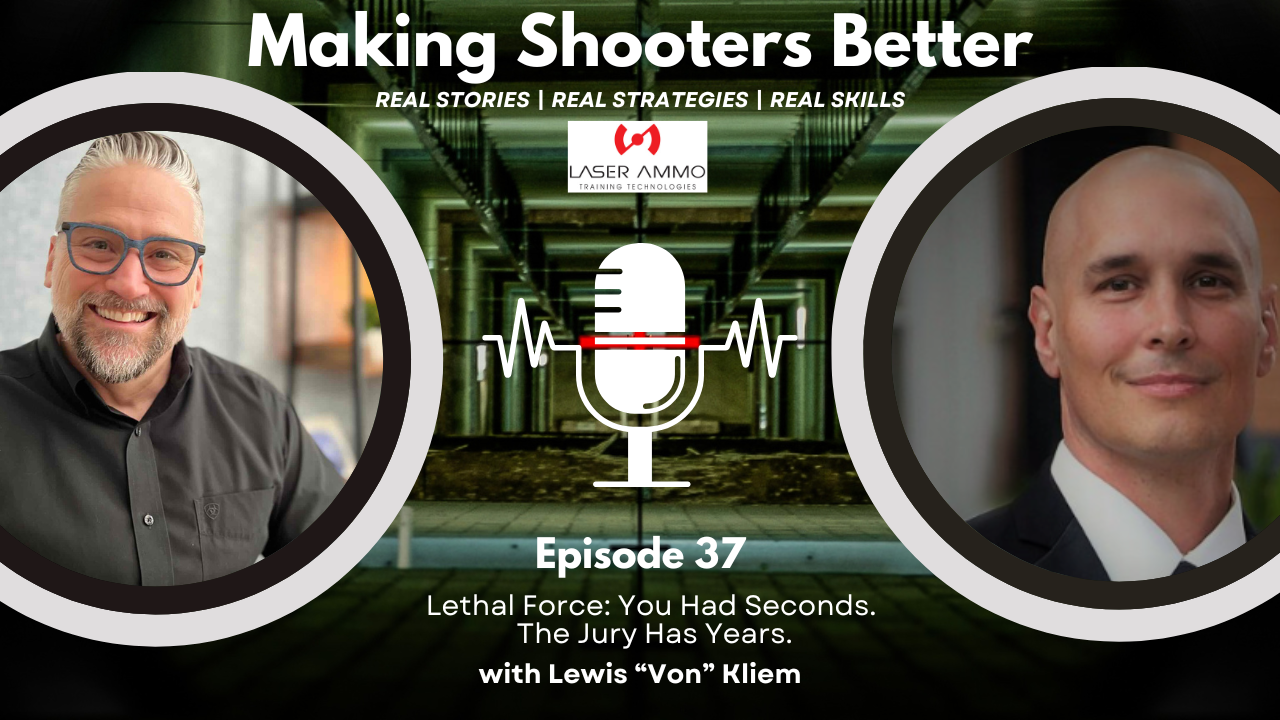
Watch the full episode of Making Shooters Better to hear Lewis “Von” Kliem explain how courts evaluate reasonable belief, why video evidence may not reflect human perception, and how law-driven training can help officers and armed citizens prepare for the legal and human consequences of force.
The complete conversation also explores jury psychology, the realities of physical violence, the cost of defending a use-of-force case, and the responsibilities carried by anyone who may need to make or evaluate a life-or-death decision.
Subscribe to the Laser Ammo YouTube channel for more conversations focused on safe firearms training, practical skill development, sound decision-making, and responsible preparation.
Follow Lewis “Von” Kliem and Force Science
Learn more about Von’s work and explore Force Science education, consulting, and training resources through the links below.
- Force Science website
- Von Kliem on LinkedIn
- Force Science on LinkedIn
- Force Science on Facebook
- Force Science on Instagram
- Force Science on X / Twitter
Making Shooters Better viewers can also use this link to request the Force Science training discount
Listen to More Episodes
You can listen to Making Shooters Better on your favorite podcast platform. Follow the show here:
- Buzzsprout: https://www.buzzsprout.com/2532363/follow
- Amazon Music https://music.amazon.com/podcasts/8156b69d-5ad9-46e9-9a4d-2baff1fbc9ef/making-shooters-better
- Apple Podcasts: https://podcasts.apple.com/podcast/id1849466402
- Spotify: https://open.spotify.com/show/5EhHThJEeV5QZ0QQn5n5CF
- Podcast Index: https://podcastindex.org/podcast/7559749
- Overcast: https://overcast.fm/itunes1849466402
- Castro: https://castro.fm/itunes/1849466402
- Podchaser: https://www.podchaser.com/podcasts/making-shooters-better-6264190
- Goodpods: https://www.goodpods.com/podcasts-aid/1849466402
- TrueFans: https://truefans.fm/65cb6a8a-c2eb-524e-b742-257cbe7bcfce
- Castbox: https://castbox.fm/vic/1849466402
- Podcast Addict: https://podcastaddict.com/podcast/making-shooters-better/6158896
- iHeartRadio: https://www.iheart.com/podcast/1333-making-shooters-better-303769503/
- Pandora: https://www.pandora.com/podcast
- TuneIn: https://tunein.com/podcasts/