



 Update
Understanding What Others Miss
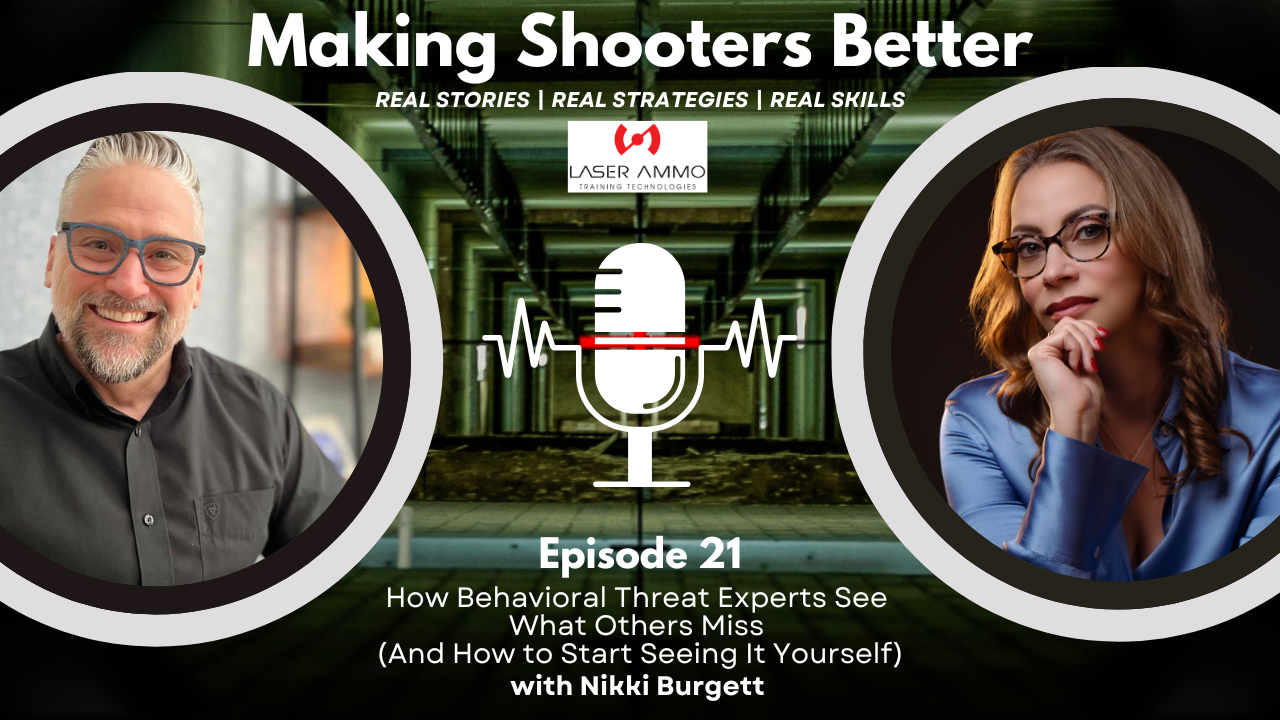
Most people believe they are paying attention to their surroundings. In reality, attentiveness is often much lower than we think. As Nikki Burgett explains in this episode, the issue isn’t just awareness—it’s understanding what you’re seeing and knowing what to do with it.
This conversation explores how behavioral threat professionals move beyond instinct and begin identifying real indicators of potential danger. It’s not about fear—it’s about clarity.
From Instinct to Insight
Many people experience a moment where something “feels off.” That instinct is valuable, but without clarity, it rarely leads to action.
Nikki explains that instinct works by picking up subtle layers of behavior, often faster than we can consciously process. The challenge is learning how to:
- Recognize what triggered that instinct
- Break it down into observable behaviors
- Communicate it clearly if needed
This shift—from feeling to understanding—is what separates awareness from effective action.
Establishing a Baseline
A core concept in behavioral threat assessment is the idea of a baseline.
You cannot identify abnormal behavior unless you first understand what normal looks like.
Two Types of Baselines
- Situational baseline: How people typically behave in a specific environment
- Individual baseline: How a specific person normally behaves
For example, behavior at a quiet restaurant will look very different from behavior at a concert. Recognizing these patterns allows you to quickly spot when something doesn’t fit.
Recognizing Anomalies
Once a baseline is established, anomalies become easier to detect. These are behaviors that stand out because they don’t match the environment.
Some examples discussed in the episode include:
- Individuals scanning others instead of engaging normally
- Unusual attention to security measures or entry points
- Behavior that doesn’t align with the setting
- Attempts to blend in after initially standing out
Often, it’s not just one behavior—but a cluster of small indicators—that signals something worth paying attention to.
The Role of Training
Training plays a major role in developing awareness. Nikki shares her own experience in law enforcement, where limited resources often meant seeking out additional training independently.
Effective training helps individuals:
- Improve observation skills
- Build confidence in decision-making
- Avoid reinforcing bad habits
- Respond more effectively under pressure
Without proper training, even repeated experience can reinforce incorrect behaviors.
Why People Fail to Act
Even when something feels wrong, most people don’t take action. Common reasons include:
- Fear of being wrong
- Concern about social judgment
- Inability to clearly explain what they noticed
- Assumption that someone else will handle it
Nikki emphasizes that reporting behavior—not assumptions about a person—is the key. Clear articulation can make the difference between prevention and missed opportunity.
Situational Awareness Without Paranoia
One of the most important takeaways from this conversation is that awareness doesn’t mean living in constant fear.
It’s possible to stay aware while still being present and engaged in everyday life. Awareness should feel natural—not overwhelming.
This includes:
- Knowing your environment
- Identifying exits and resources
- Trusting your instincts while seeking clarity
- Taking action when necessary
Empowerment Through Awareness
At its core, behavioral threat assessment is about empowerment.
Understanding what to look for gives individuals the ability to:
- Protect themselves and others
- Recognize potential threats earlier
- Make better decisions under stress
- Contribute to overall community safety
Awareness is not just a personal skill—it’s a shared responsibility.
Watch the Full Conversation
This episode offers real-world examples and practical insights into how threats develop and how they can be recognized early. Nikki Burgett breaks down complex concepts into clear, actionable ideas that apply to everyday environments.
If you want to improve your awareness, better understand behavior, and make smarter decisions in uncertain situations, this is a conversation worth watching.
Be sure to follow Nikki Burgett and subscribe to the Laser Ammo YouTube channel for more episodes of Making Shooters Better focused on practical, responsible training.
Listen to More Episodes
You can listen to Making Shooters Better on your favorite podcast platform. Follow the show here:
- Buzzsprout: https://www.buzzsprout.com/2532363/follow
- Amazon Music https://music.amazon.com/podcasts/8156b69d-5ad9-46e9-9a4d-2baff1fbc9ef/making-shooters-better
- Apple Podcasts: https://podcasts.apple.com/podcast/id1849466402
- Spotify: https://open.spotify.com/show/5EhHThJEeV5QZ0QQn5n5CF
- Podcast Index: https://podcastindex.org/podcast/7559749
- Overcast: https://overcast.fm/itunes1849466402
- Castro: https://castro.fm/itunes/1849466402
- Podchaser: https://www.podchaser.com/podcasts/making-shooters-better-6264190
- Goodpods: https://www.goodpods.com/podcasts-aid/1849466402
- TrueFans: https://truefans.fm/65cb6a8a-c2eb-524e-b742-257cbe7bcfce
- Castbox: https://castbox.fm/vic/1849466402
- Podcast Addict: https://podcastaddict.com/podcast/making-shooters-better/6158896
- iHeartRadio: https://www.iheart.com/podcast/1333-making-shooters-better-303769503/
- Pandora: https://www.pandora.com/podcast
- TuneIn: https://tunein.com/podcasts/