


 Update
Inside the FLETC Firearms Simulation Study: Comparing Laser and Live-Fire Training
For years, firearms instructors have debated the value of laser training and simulation. Can practicing without recoil or live ammunition truly prepare someone to shoot accurately on the range?
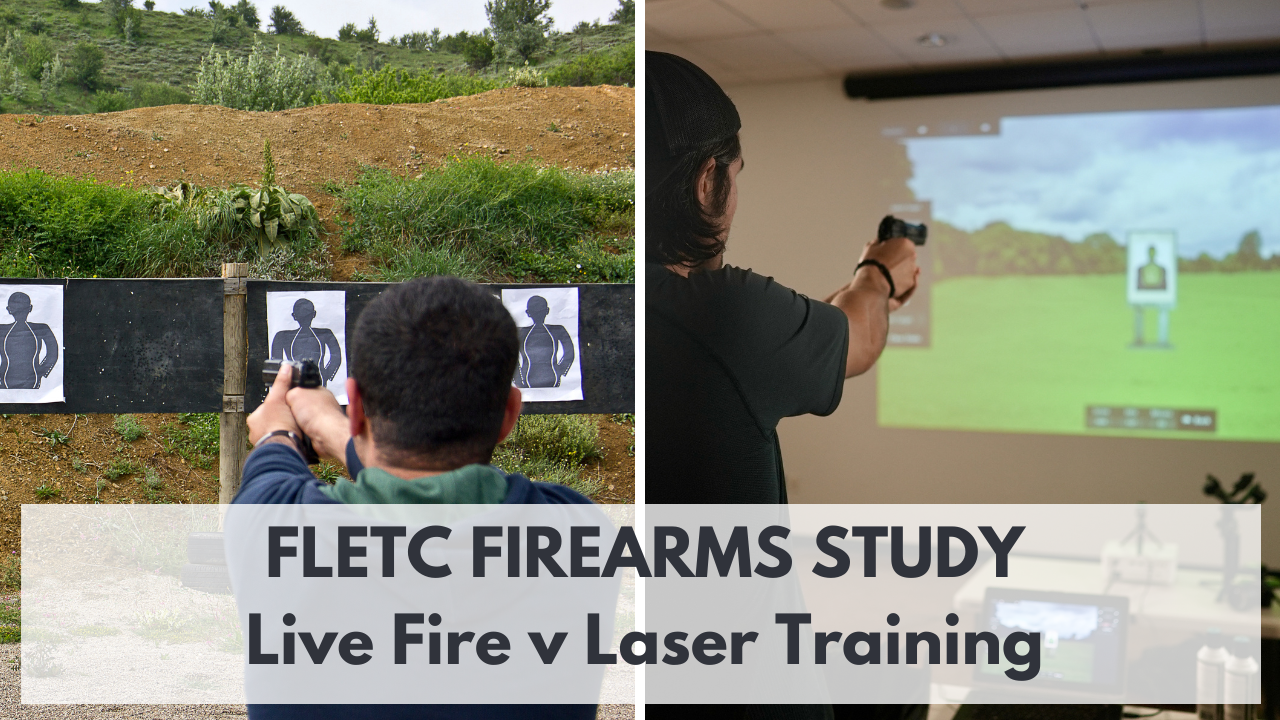
To answer that question, the Federal Law Enforcement Training Center (FLETC) conducted a formal research study published in the Spring 2011 edition of the FLETC Journal. The article, titled "Firearms Simulation Study," was authored by Steve Hawthorne and Terry Wollert, Ph.D., in Training Innovation, along with Rodney Burnett and Kevin Erdmier in Firearms. Their research compared traditional live-fire instruction with laser-based firearms simulation during introductory marksmanship training to determine whether students who learned the fundamentals with laser simulation performed as well as those trained using conventional live-fire methods.
Rather than relying on opinions or anecdotal experience, FLETC measured actual qualification scores to determine whether simulation-based instruction produced comparable results.
The findings may surprise many shooters.
Why the Study Was Conducted
Technology has become an increasingly important part of professional training. From flight simulators and driving simulators to virtual interview training, simulation allows students to develop skills in a safe, repeatable environment before performing them in real-world situations.
FLETC had already incorporated laser-based systems into judgment shooting exercises and wanted to determine whether similar technology could effectively teach the fundamentals of marksmanship. Specifically, researchers wanted to know whether students who learned the basics using a laser training pistol would perform differently than students who learned those same fundamentals with live ammunition.
Focusing on the Fundamentals
The study centered on Basic Marksmanship Instruction (BMI), where new shooters learn the core building blocks of handgun shooting:
- Proper stance
- Grip
- Sight alignment
- Trigger control
Researchers selected a laser training simulator paired with Glock training pistols equipped with resetting triggers and infrared laser inserts. Each trigger press generated an invisible laser, allowing the simulator to instantly display shot placement while eliminating recoil and live ammunition.
One advantage researchers highlighted was immediate feedback. Unlike traditional dry fire, where the shooter may not know exactly where the shot would have landed, the laser system displayed point of impact after every trigger press, helping instructors identify and correct shooting errors immediately.
Why the Study Used Non-Recoil Training Pistols
One of the more interesting aspects of the research was the decision to use non-recoil laser pistols.
The researchers reviewed previous military studies suggesting recoil was not required when teaching basic marksmanship fundamentals. They also noted that recoil simulation systems available at the time often introduced reliability issues, required external CO₂ systems, or significantly increased costs.
Because the goal was to evaluate the effectiveness of teaching fundamental shooting mechanics—not recoil management—the study intentionally focused on non-recoil laser pistols.
The First Phase: College Students
The initial study involved 14 criminal justice students from the College of Coastal Georgia.
Participants were grouped based on age, gender, and previous handgun experience before being randomly assigned to either:
- Laser-based Basic Marksmanship Instruction
- Traditional live-fire Basic Marksmanship Instruction
After completing introductory instruction, every participant finished the same live-fire Semi-Automatic Pistol Course and completed the same qualification course.
The results were remarkably close.
Students trained with the laser system averaged a qualification score of 257.8, while students trained with live fire averaged 260.4—a difference of only 2.6 points. Because of the small sample size, researchers could not draw statistical conclusions, but the results were encouraging enough to expand the study.
Expanding the Study
To obtain a statistically meaningful sample, FLETC partnered with the United States Marshals Service.
Three Criminal Investigator Training Program classes participated, bringing the total study population to 140 students.
As before, students were matched by age, gender, and prior military or law enforcement experience before being randomly assigned to either laser-based or live-fire Basic Marksmanship Instruction. All students then completed the same 18-hour live-fire pistol course before shooting their final qualification.
The Results
The larger study produced nearly identical outcomes.
Average qualification scores were:
- Laser training group: 275.8
- Live-fire training group: 278.2
Statistical analysis found no significant difference between the two groups.
Researchers also compared these scores to previous U.S. Marshals Service classes that had received only traditional live-fire instruction.
Again, the average qualification score for students who trained with laser pistols during Basic Marksmanship Instruction matched the historical average for traditional training, further supporting the conclusion that introductory laser training did not negatively impact shooting performance.
Prior Experience Didn't Change the Outcome
Researchers also examined whether previous firearms experience influenced the results.
Among students with military or law enforcement backgrounds:
- Laser group average: 280.1
- Live-fire group average: 282.5
Among students with no prior experience:
- Laser group average: 265.0
- Live-fire group average: 266.8
Neither comparison showed a statistically significant difference.
Benefits Beyond Qualification Scores
While qualification performance was the primary focus, instructors identified several practical advantages to simulation-based instruction.
Because no live ammunition was being fired, instructors and students could communicate normally without hearing protection. Instead of shouting commands across a firing line, instructors could stand next to students, observe grip, trigger press, and sight alignment more closely, and provide immediate coaching.
One instructor noted he could identify subtle errors in weapon handling that would have been difficult to see during live-fire training.
Researchers also pointed to several operational benefits:
- Reduced ammunition costs
- Lower range maintenance expenses
- More available live-fire range time
- Ability to conduct training indoors regardless of weather
- Greater classroom flexibility for agencies without dedicated ranges
Live Fire Still Matters
Importantly, the study never argues that simulation should replace live-fire training.
Researchers acknowledge that recoil management, muzzle blast, emergency reloads, and malfunction drills remain important skills that require live-fire practice or more advanced simulation systems.
They specifically recommend future research involving recoil-enabled simulators while recognizing that no simulator can fully reproduce every aspect of firing a real handgun.
The Bottom Line
The FLETC study reached a balanced conclusion.
Students who learned introductory marksmanship skills using non-recoil laser handguns achieved qualification scores that were statistically similar to students who began with traditional live-fire instruction. Researchers concluded that simulation offers meaningful instructional advantages, improves safety during early training, reduces costs, and serves as an effective tool for teaching foundational shooting skills.
At the same time, the authors emphasize that simulation is not a replacement for live fire. Instead, it should be viewed as an effective way to build core shooting fundamentals before progressing to the range, where students can apply those skills under live-fire conditions.
How We Can Help
While the FLETC study focused on introductory marksmanship using laser simulation, today's training technology goes well beyond teaching the fundamentals. At Laser Ammo, our training solutions are designed to help shooters build, reinforce, and challenge their skills at every stage—from new firearm owners to experienced competitive shooters, instructors, law enforcement, and military professionals.
The Smokeless Range® simulator serves as the foundation of an immersive training environment and can be enhanced with products like the gunSHOT BOX™, Shot Body System, and Simulated Injury System (SIS) to introduce stress, distractions, physical limitations, and unexpected variables that better reflect real-world encounters. Add in Interactive Multi-Target Training System (i-MTTS™), CQB in a Box, and a growing library of software add-ons (like VST Pro for scenario training) to add further shoot/no-shoot decision-making, judgment training, competitive drills, and skill-building exercises, and shooters can train for far more than simply hitting the target.
Whether you prefer recoil-enabled training firearms, dedicated non-recoiling training pistols, or laser cartridges that allow you to train with your own firearm, Laser Ammo offers solutions for virtually every training style and experience level. If you're not sure which option is right for your needs, be sure to read our companion article, "Which Laser Training Firearm is Right for You? | Laser Ammo Buying Guide", which compares the available training platforms and helps you find the best fit for your goals.
Whether you're with the military, law enforcement, or are a veteran, be sure to ask about our exclusive professional discounts by contacting one of our Military/Law Enforcement specialists. Reach out to Colin at Colin@LaserAmmo.com or call 516-858-1262 ext. 105 to learn more. Firearms instructors can also take advantage of our Firearms Instructor Affiliate Program and exclusive discounts. For any other questions, our team is always happy to help—simply contact us.