



 Update
Moving Beyond Qualification: Rethinking Firearms Training for Law Enforcement
Our own Colin Gallagher, Laser Ammo’s Military & Law Enforcement Lead, recently contributed an article to Calibre Press’ Training Network titled “Beyond the Qualification Line: Why Law Enforcement Should Embrace Practical, Tactical, and Competitive Shooting.” In it, he challenges the long-standing reliance on traditional qualification standards and makes the case for a more comprehensive, performance-based approach to firearms training. You can read the full article on Calibre Press for the complete perspective and insights directly from Colin.
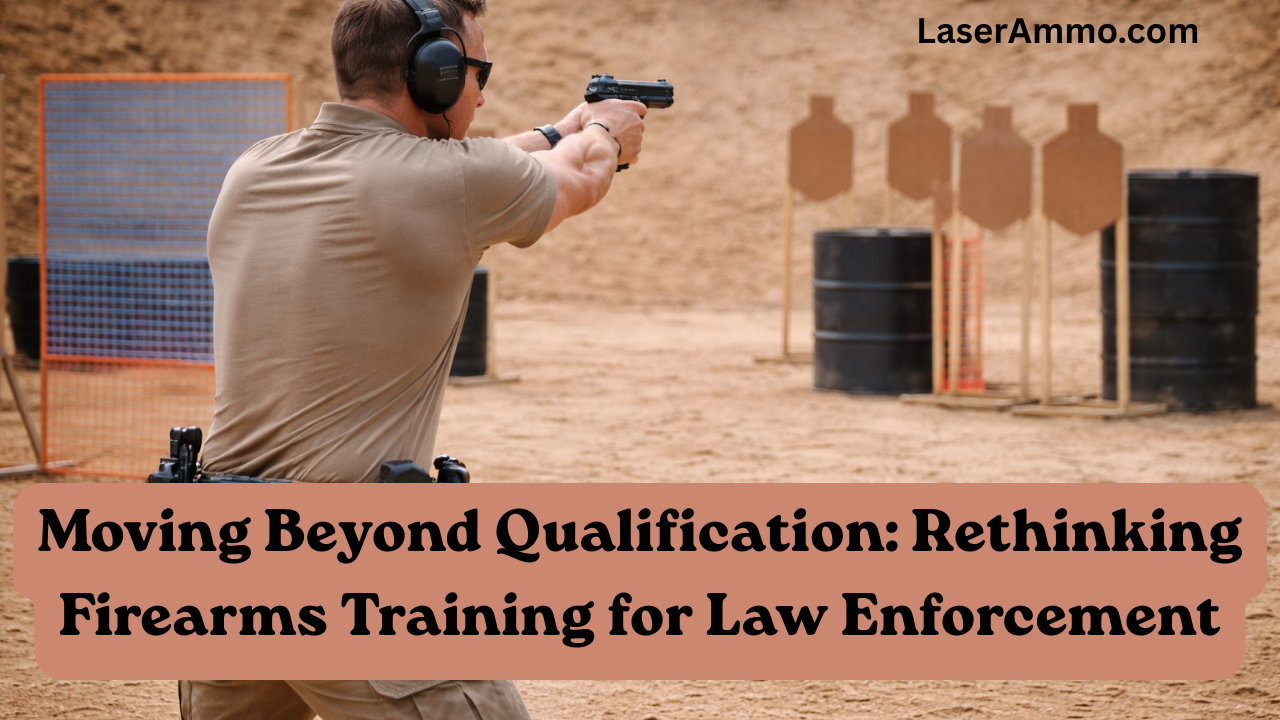
The limits of qualification-based training
For many agencies, qualification is the benchmark. Officers must meet a minimum standard, often on a static range, to demonstrate proficiency. While necessary, this type of training tends to focus on passing a test rather than building real-world capability.
Qualification alone does not fully prepare officers for dynamic, unpredictable situations where movement, decision-making, and stress all come into play.
Real-world performance requires more than fundamentals
In the field, situations rarely resemble a controlled range environment. Officers must process information, make rapid decisions, and execute under pressure.
Colin emphasizes that training should reflect these realities. That means incorporating movement, transitions, timing, and situational awareness—skills that go beyond standing on a line and shooting at a fixed target.
Practical and tactical shooting
Practical and tactical shooting disciplines introduce elements that mirror real-world encounters more closely. These approaches encourage officers to think, adapt, and perform in evolving scenarios rather than simply execute a predetermined course of fire.
Training in this way helps bridge the gap between technical skill and applied performance.
Why competition can be a training asset
Competitive shooting is often overlooked or misunderstood in law enforcement circles, but it offers significant benefits. It introduces stress, time constraints, and performance pressure in a controlled environment.
Officers who engage in competitive shooting can develop:
- Faster target acquisition and transitions
- Improved accuracy under time pressure
- Greater confidence in their abilities
These are all transferable skills that can enhance real-world performance.
Shifting the mindset
One of the key takeaways is the need for a mindset shift. Qualification should not be the end goal—it should be the baseline.
Agencies that prioritize ongoing skill development, scenario-based training, and performance under stress will better prepare their officers for the realities they face.
A more complete training approach
Expanding firearms training doesn’t mean replacing existing standards—it means building on them. By incorporating practical, tactical, and competitive elements, agencies can create more well-rounded, capable officers.
This approach not only improves individual performance but also strengthens overall readiness and effectiveness.
Check out the full article from Colin above. If you have any questions, feel free to reach out to him.