



 Update
Closing the Courtroom Training Gap in Law Enforcement
Colin Gallagher, Laser Ammo’s Military & Law Enforcement Lead, recently contributed an article to Calibre Press addressing a critical gap in law enforcement training—courtroom testimony. Drawing from real-world experience working with agencies and instructors, he breaks down why this skill is often overlooked and what needs to change. Read the full article here: The Testimony Gap: Why Law Enforcement Must Elevate Courtroom Training Standards
Law enforcement training is built around performance in the field. Officers spend countless hours developing tactical skills, decision-making, and control under pressure. But as Colin points out, one of the most important moments in an officer’s career often happens later—in a courtroom. And that’s where a major gap exists.
A skill that carries more weight than it gets
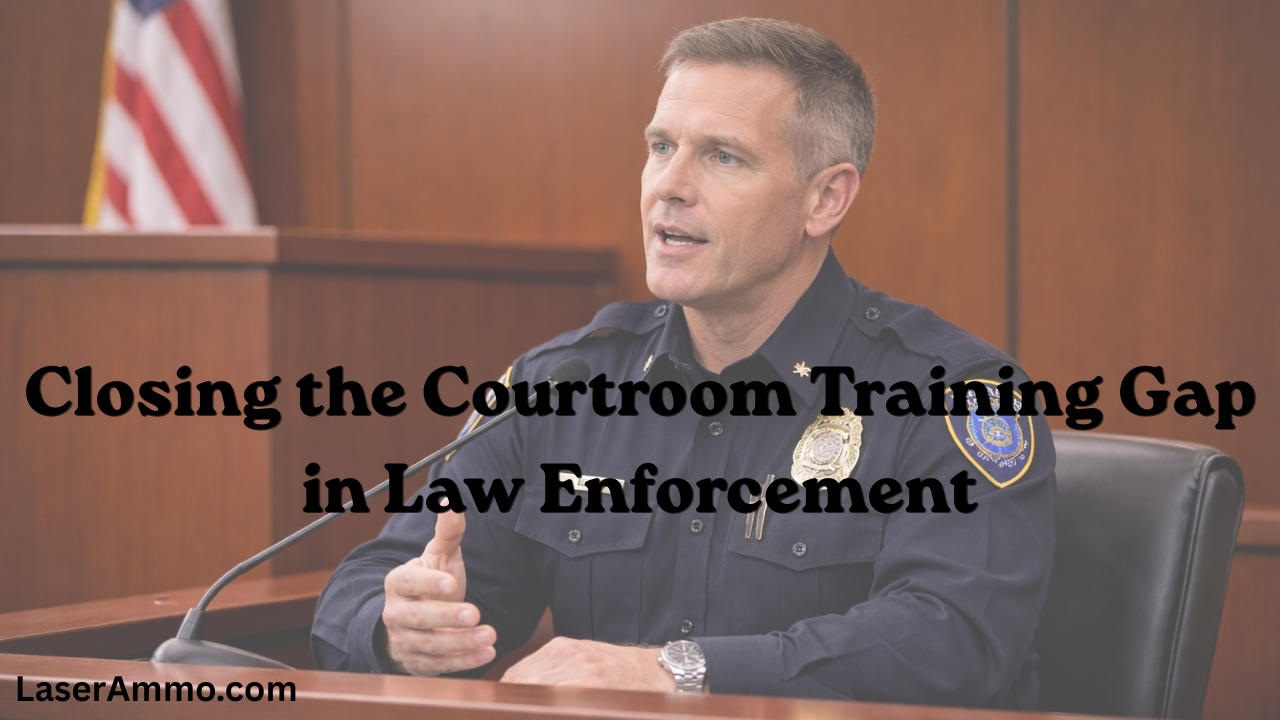
Testifying in court isn’t a secondary responsibility—it can directly impact case outcomes, credibility, and public trust. Yet it’s often treated as an afterthought in training programs. Officers who are highly capable on the street may find themselves at a disadvantage when it comes time to clearly and confidently explain their actions on the stand.
A completely different environment
The courtroom is fundamentally different from anything officers train for. In the field, they are in control—making decisions, managing situations, and taking action. In court, that control is gone. Every word is questioned, every detail scrutinized, and the pressure comes from a different direction.
Without preparation, that shift alone can cause even experienced officers to appear uncertain or inconsistent.
High expectations with minimal repetition
Most officers receive limited exposure to courtroom testimony during their academy training, and little to no follow-up after that. Despite this, they are expected to recall detailed incidents long after they occur, explain their decisions clearly, and handle cross-examination from experienced attorneys.
Like any critical skill, this requires practice—and without it, performance can suffer.
Perception matters as much as facts
In the courtroom, how something is communicated can be just as important as what is communicated. Jurors are not only listening to the facts—they are evaluating confidence, clarity, and consistency.
If an officer appears nervous, defensive, or unclear, it can influence how their testimony is received. Even small inconsistencies can be magnified, creating doubt where none may have existed.
The mindset mismatch
Officers are trained to act decisively and take control in dynamic situations. But those same instincts can work against them on the stand.
Over-explaining, becoming defensive, or reacting emotionally under pressure are common responses—and they can weaken credibility, even when the underlying actions were sound.
What needs to change
Colin’s message is clear: courtroom testimony should be treated as a core competency, not a one-time lesson. Just like firearms or defensive tactics, it requires ongoing, realistic training to build confidence and consistency.
Agencies that invest in this area will see stronger performance not just in court, but across the board.
The takeaway
Closing the testimony gap isn’t just about improving outcomes in individual cases. It’s about professionalism, consistency, and maintaining trust in the process.
If officers are expected to perform under pressure in the courtroom, they need to be trained for it—just as thoroughly as they are for the street.
Want to read the full article.. head on over to Calibre Press' Training Network and take it all in.